Indian Summer has arrived here in southern Wisconsin, warm sunny days after the first frost. The days are pleasant, and the nights are cool and bug free - heaven. The colors here in Rock County are starting to peak, the trees gaudy in russets, oranges, and shades of gold. We had a little trip this week on the Mississippi River, an alternative to our usual drive up the River Road from Prairie du Chien to Lake Pepin. This time we saw the scenery from the middle of the river.
Dick booked us on an excursion boat called the Celebration Belle. We left from Dubuque, went up river sixty or so miles to Prairie du Chien, stayed overnight in a motel, then returned the next day. There was good food on the boat, and live music all the way, but the real reason to go is to see the river, the bluffs, the trees, and the bald eagles.
The Mississippi was a flood stage, since heavy rains about a week ago. At Dubuque many docks were under water, same with riverside parks and some cottages.
This is lock and dam 11 near Dubuque. The gates are all open, since the river is at flood stage. The boat still goes through the lock since otherwise the current would be too swift to control the boat.
This is one of the three captains on the excursion boat. The pilots house was open, and we could go in, watch, ask questions, and get a good look at their navigational equipment.
There weren't many pleasure craft out, since the current was so swift, and there was so much debris in the water, though we did see a couple canoeists.
The trip went past some little villages, like Specht's Ferry, Cameron, and Guttenburg, Iowa.
Freight trains run all along both sides of the river, and when they sound their horns it echoes off the water and the limestone bluffs.
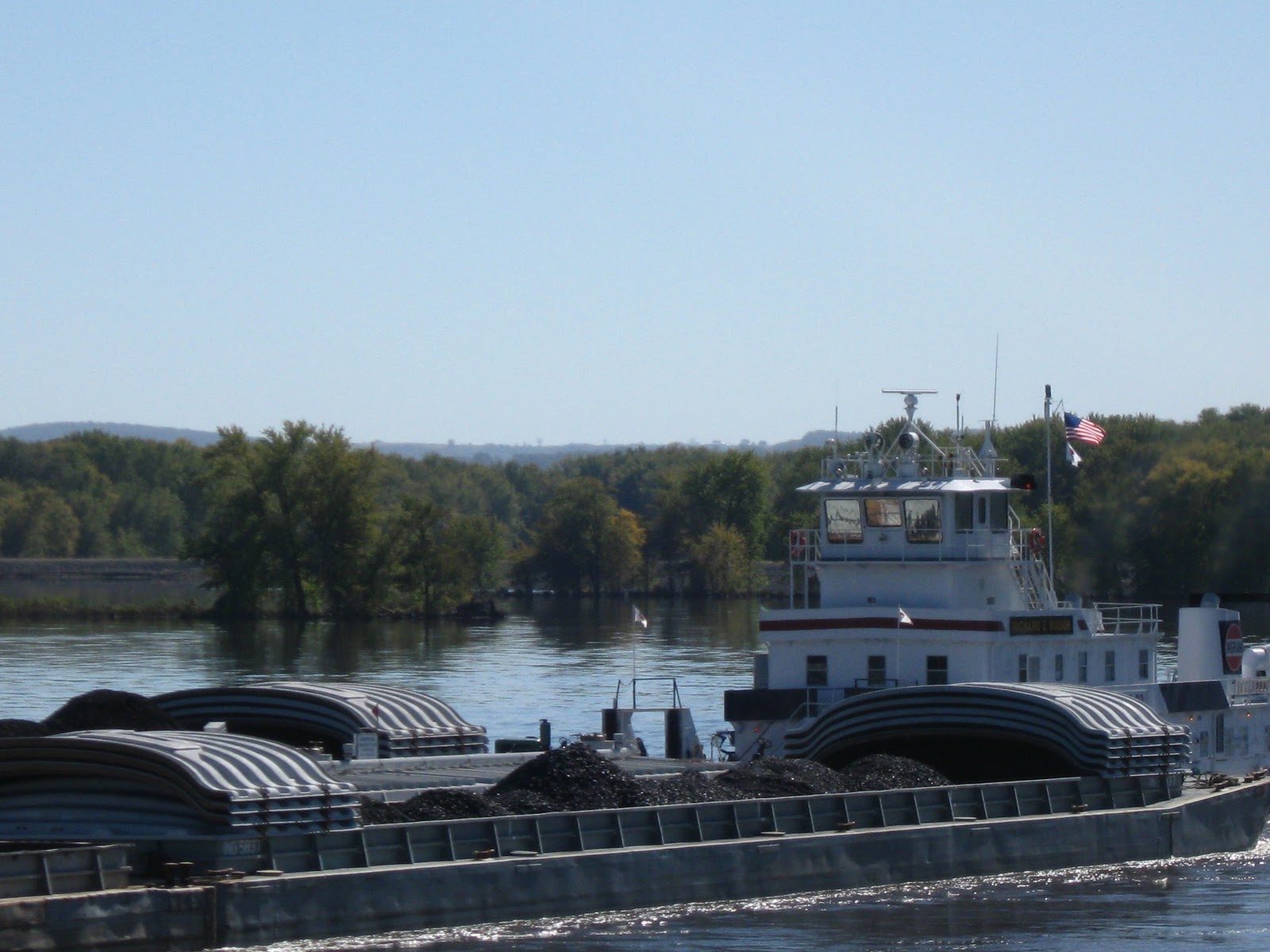
There were a couple dozen tow boats with barges on the upper Mississippi, but this is the only one we saw.
What we mostly saw was blue sky, wide expanses of water, flooded islands, and at least a dozen bald eagles. It was relaxing, lovely and a good way to celebrate autumn.
A Baby Boomer's musings on art, family history, reading and finding a little beauty each day.
Showing posts with label train. Show all posts
Saturday, October 9, 2010
Monday, June 22, 2009
Sounds From the Past, part 2

Anna Bernice Adams, later Bernice Ann Smith
I've been continuing the slow process of transcribing the tape my mother helped my 92-year-old grandmother make back in December 1994. My husband says it's strange hearing their voices coming from the studio where I work; I guess it is. Like ghosts, almost. At the beginning she is still talking about living on the "Big B" ranch, which was in the southeastern part of Washington, not far from the Columbia River, and the Tri-Cities area today.
Bernice Tess interview pt 2
We had more horses than cows, because cows were purely for our own use. The horses were for sale and for breeding purposes. We had a lot of horses, and a lot of hired men and a great big lot of land. Four square quarters of wheat. I used to ride on my special mare all around the acres. It seemed like we’d go forever and still be on “our land” I called it, because to me it was our land. It eventually did become our land because my mother ended up marrying the manager of some of the land, the son of the man who owned it, and that was a turning point in my life.
It was my eleventh year. Everything seems to have happened in my eleventh year. My real father was shot and murdered when I was eleven years old, and six months after that my mother told me she was marrying again. The only son that was managing the ranch. Which was not particularly good news to my ears because I didn’t think he liked me, and I knew I was very much afraid of him, because I had been taught to be afraid of him. Because he didn’t like children. Well of course I would grow up.
So, then I was sent away to school. To a Catholic school, and I was the only Protestant in the whole school. In the questions that my granddaughter Sherry asked, she wanted to know some of the people who had had a big influence on my life, and that I admired. And even though the girls were so hostile to me, there was one of the sisters. Because it was a Catholic school with sisters and priests, they went out of their way to be very very nice to me, and they really made up for it. – the coolness of the Catholic children. And this one sister, I think her name was sister Teresa, she encouraged me very much in my English and my composition. And I remember her telling me one time that she hoped some day to read an article or a novel or a piece of fiction, that I had written with my name on it because she was sure I would become a great author. Of course I would have disappointed her, because I never went on to college, and I never wrote anything that outstanding. I loved to read, but it was other people’s writings I enjoyed, not my own. That lasted, I was in the academy one full year, practically.
At the end of it they came and took me to Hillyard, no I think we went to Spokane first. I know that we lived very near the Jesu Church, and they told me there that next to that church was were there was a little house , not very big, and they said that was where - what was that singer? Bing Crosby was born, just a block from where we lived. And I always thought that was very exciting. Our house there was very small, not pretentious at all. But it was wonderful to me because I’d never had an inside toilet before, electric lights before. It was the first time in my life I’d ever had electricity or any of the nice things about living.
Carol: How old were you then, Mother?
Oh, I was eleven years old yet; that was my eleventh year. That’s my daughter, I’m glad they’re asking me questions, because that’s what I want .
My best friend died while I was still eleven. She was – I considered her my best friend. She lived next door, and she as a lovely sweet Catholic girl. But she didn’t hold my being a Protestant against me. She was, we were, very very close friends. And she played tennis with her brothers one morning and fell against the wire that was put up between the two poles. And I never understood how, but somehow she hit her head on the wire and died instantly. And that was a terrible shock to me. So I had lost two dear people that year, that I loved.
Then I had the news given to me that I was to have a new baby brother or sister. Well, I was pleased about that, I guess. In the beginning it was such a shock to me I couldn’t hardly comprehend what was happening. But I was, later, it made me very happy, and I always enjoyed having a brother. It was wonderful, because I’d never had a sister or a brother. And I, I thought as much of him as I possibly could, of a real, full brother. And he never wanted me to call him a half brother. He was really angry with me if I said that he was my half brother. He always said, “There are no halves in our family, just wholes.” And that’s the way it was, all through our lives.
I’m sorry for the interruption, one of my daughters just told me that I hadn’t told my brother’s name. His name was DuRell. And that was a family name from Dr. Smith’s side. His mother was a Durrell. She was French, French Dutch, or Dutch French; I don’t know which it would be. I always considered her more Dutch than French.
Carol: Is that the diamond that Sherry has?
Pardon me, Carol’s asking something.
Ellen: Is that her diamond that Sherry has?
Yes, Sherry has her diamond. And it was mine for a while, and before it was mine, I guess it was Dr. Smith’s mother’s. Yes.
Carol: You never said who your stepfather was either.
Carol said I never said who my stepfather was.
Carol: He wasn’t a doctor then.
He was not a doctor at that time. But that’s when we came back to Milwaukee he decided to become a doctor. And we had eleven long years ahead of us. And they were not easy years. We had DuRell to raise, and we had ourselves to take care of. Because his folks did not approve of him coming out there.
I wasn’t happy about leaving Hillyard, It seemed as though my life was just a series stops and starts m strange people, and losing friends, making friends and losing them. So I was very unhappy about the trip way “back East”, as we called it, although really it was only half way. But, we boarded the train. I couldn’t take any of my toys.
Speaking of favorite toys, Sherry once asked me which one was my favorite. And I did have a favorite doll? I had very few toys as a small child, because we moved so much and I never had a place to keep them. So, this doll was very special. The last time I ever saw my father, he brought the doll to me. Mother and I went to Seattle, no, we went to San Francisco, right after the fire, and the earthquake. And we went to a big hotel, ‘course most of the hotels were burned out then, and we could still see the black skeletons of them, and the ruins of bricks that were left, and the burned out houses. I can remember asking my mother what happened, and she said that they’d had a terrible fire after an earthquake. Anyways, afterwards we met my father at this hotel, and he had a big present for me. And it was a doll, a walking doll, and big, came up to my knees you know. And I treasured that doll more than anything I ever had, but I had to leave it behind with all the rest of my things when we started out for our new life in Milwaukee.
Being on the train was an experience. We had a baby, of course, DuRell was very small, ten months old when we left. And we had to get our own meals. We had just what we could buy at stops. The train would stop and we could get off and buy things to cook on the stove, which was an old coal stove. The conductor put coal in, and some people heated up soup. And we heated up DuRell’s milk on it. And, the smell, of the coal smoke was not nice. We could, everything in the car smelled of oranges and coal smoke. Because so many of the people ate oranges to get the taste of coal out of their throats. And I always well remember that smell - coal smoke and oranges, mixed. To me, that’s train smell. And the conductors were very friendly, They’d come around very often, and set and talk, and play with the baby. But it was a very hard trip with a small child. And we had lost so much that we left behind that I was very sad.
I wasn’t happy about going to this new city. When we finally got there it was a long trip,, we slept in relays. We had just the chairs that we made into a bed at night, with a curtain that came round them. And we’d sleep for a little while, and then somebody else would get up and they would sleep, because we only had the two seats. Double seats. For the three of us. No, four of us, with the baby. So it was very cramped, very uncomfortable, And we were glad when we crossed the big muddy river, and finally landed in Milwaukee. The muddy river was the Mississippi. And I remember they got me up out of sleeping to go and look at it, and I was so anxious to see the Mississippi, all the things I heard about the mighty mighty Mississippi, and how beautiful it was. And I looked at it and was so disappointed. All it was, it looked like mud, like a river of mud. A big wide river of mud. And of course further on it looked much better, but that was near the big cities and it was very polluted. So I was disappointed in that.
Labels:
art,
dolls,
drawing,
family,
school,
sketchbook,
train,
Washington
Thursday, May 28, 2009
Postcards from Washington

Mt. Saint Helens and Spirit Lake, Washington

Bonneville Dam, Columbia River

Cans of salmon, Washington state

Aerial view of Spokane, Washington

Lower falls at Spokane, Washington
I returned from my two week train/driving trip to Washington state on Sunday, and I'm just beginning to catch up on laundry, mail, cleaning and my rest. I still haven't downloaded the zillion pictures I took from my digital camera. I'm behind in my reading, my gardening, my art. I had hoped to do sketching on the trip, but we seemed never to sit still for very long, except on the train from Columbus, WI to Spokane, WA. I tried drawing a little in a Seattle park at the end of the vacation, but the magic of seeing someone doodling in a notebook just made me several friends in the park where I was working. Looks like I'll be working from memory and photos once again.
The short version of the trip was that my sister-in-law invited me to join her on vacation, and agreed to let me track down some distant cousins and quiz them on family history. In addition she agreed to let me experience the less touristy part of Washington east of the Cascade Mountain range. We took the train to Spokane, had a cousin tour us around that city. We rented a car and drove to Fairfield, where my maternal great-grandparents raised their family, and where many cousins are buried and some still live today. We headed south toward the Tri-Cities area, where Grandma lived on a wheat ranch, and where the Hanford Nuclear Reservation stands. We drove up the Columbia River gorge, and up to both Mt. Saint Helens and Mount Rainier. Then we drove around the Olympic Peninsula, spending three days at lodges in the rain forest and along the Pacific Ocean. We ended up in Seattle, where we boarded the train for the two day ride back home.
It was wonderful - and exhausting. We met good people, ate good food, and had a good time. We saw antelope, bison, moose, elk and mountain goats from the train, and lots of other fauna and flora closer up.
I hope to write more specifically in the upcoming days, but this will serve as a beginning.
Labels:
family,
postcards,
train,
travel,
Washington
Sunday, December 16, 2007
Still More of a Murder Mystery

postcard image of a logging train
It's Christmas card time, and my most interesting mail came from Fairfield, Washington. One of my grandmother's cousins, who has been looking through microfilm of old Skagit River area newspapers, turned up two more articles about my great-grandfather's shooting in 1914. These clippings send me scurrying to the internet to search for more, and while I haven't found anything about Grandpa Adams, little by little a picture of the area at that time is emerging. I learned, for example, that two kinds of entertainment for men in the Hamilton, Sedro-Woolley area in 1914 were visiting the saloons (this is just six years before Prohibition), and attending the circus. Saloons in logging towns provided a place to socialize, play cards or shoot pool, drink, smoke, and often they were the location of the only public toilet in town. Evidentally the Al Barnes Circus visited the area yearly, complete with acrobats, a freak show, and a menagerie of wild elephants. In 1922 a huge elphant named Tusker escaped from the same circus and rampaged downtown Sedro-Woolley. That's another story. One writer, describing the logging town suggested that it resembled the town in the film McCabe and Mrs. Miller. These tid-bits are helping me form a mental picture of the time and place in which my great-grandfather lived and died.
Here is the first article.
The Mt. Vernon (Washington) Herald, Thursday, May 28, 1914.
Vol. 31, No. 14
MEN FIGHT; ONE KILLED
Matt Snyder, a logging engineer in the employ of the Hamilton Logging Company, shot L.E. Adams, also a logging engineer, to death about 1:30 o’clock Sunday morning following their return from a circus at Sedro-Wooley where both became intoxicated and started a quarrel. Both men are old in the service of the company and both are well known in the Hamilton district. Snyder has a wife and baby and the wife says she handed her husband a gun with which to kill Adams after Adams had thrown Snyder to the ground and was beating him with brass knuckles. The tragedy occurred in front of the Snyder home in Hamilton.
The two men had been on bad terms for some time, owing to a disagreement over their work, Adams thinking he was entitled to the train run which had been assigned to Snyder. When they met at saloons in Sedro-Wooley Saturday they had words and continued to quarrel until the tragedy occurred on their way home the next morning.
Mrs. Snyder and her baby accompanied Snyder to the county jail and spent a night in jail with him. She was held temporarily but later released, Prosecutor Beagle having no fear that she might try to escape.
The shooting was not reported to Superintendent Lyle McNeil, of the Hamilton company camp, until an hour and a half following the tragedy.
Snyder will be tried at the June term of court when 20 other criminal cases will be heard.
Subscribe to:
Posts (Atom)