Showing posts with label Books. Show all posts

Tuesday, January 8, 2019

Something Bookish

The Readers - 12x24 inch oil on canvas

Last year was a better reading year than I thought.  Looking back over my Goodreads page, I see that I finished sixty books, which is nowhere near the number I used to go through in a year, but better than I thought, considering the amount of time I spent napping or going to medical appointments in 2018, and the fact I started listening to Sirius radio instead of audio books in the car.

Looking back over the titles I completed did quite a lot of re-reading of titles I enjoyed in the past, and a higher than usual percentage of non-fiction titles. The older I get, the more I like memoirs. I was also interested in the book about how Janesville was affected when the GM plant shut down ten years ago.  I thought I knew more about that situation than I actually did.

Anyway, these are some of my favorites from 2018:

Moonglow - Michael Chabon
News of the World - Paulette Jiles
The Painted Drum - Louise Erdrich
War and Turpentine - Stefen Hertmans
All Quiet on the Western Front (reread) - Erich Maria Remarque
Chang and Eng - Darin Strauss
On the Move: A Life - Oliver Sacks
All Creatures Great and Small (reread) - James Herriot

Saturday, April 22, 2017

Portrait Revolution

Spring is, well, springing in southern Wisconsin, and I have not been in the studio very much at all.  In fact, most of my time has been spent working outside, especially at the local cemetery where I photograph for Find a Grave, and also planning my upcoming May walking tour of the historic parts of the cemetery. I enjoy both doing research and getting outside to stretch my legs.


I have been working in sketchbooks a bit, and on a self-portrait. But today I'm tooting my personal horn about being included in a new art book called Portrait Revolution: Inspiration From Around the World For Creating Art in Multiple Mediums and Styles, by Julia L. Kay. Julia Kay started an online group on Flickr devoted to drawing a painting portraits.  People join the group, post photographs of themselves, and then are free to interpret the photos in any way.  Some people draw, some paint, some use digital media, one even did portraits on an Etch-A-Sketch. Some portraits are realistic, while others veer into abstraction or caricature.  All are interesting.


Anyway, months ago I was asked to submit a couple portraits for the book.  I was flattered to be asked, but had no idea what the final product would be like.  This past week I ordered and received my copy, and was thrilled to see what a beautiful book it is.


When I was first contacted about including two of the portraits I did, I was a little disappointed that the ones they chose were not favorites of mine.  But looking at the book now I can see what an effort was made to include a wide variety of artists, and a wide variety of media and artistic approaches.  I tend to experiment a lot, and both of my portraits included here reflect that. One is rather abstract and brightly colored, the other is a monoprint, enhanced with colored pencil.  I love seeing the way the folks who compiled these portraits show the original photo, plus several different approaches JKPP folks used to create art.

So thank you, Julia Kay for bringing together so many diverse folks from around the world to create art, and to find artistic kindred spirits.

Saturday, March 4, 2017

Coming Back

This morning I'm honking into my Kleenex, barking out ragged coughs, and slouching around the house in my wooly socks and slippers.  And the thing is, I'm feeling much better.

What is it about taking a nice winter vacation?  Why can't I just pack my bag, go have fun, and be done with it?  Why must I be a magnet for other people's viruses?  It happened last year in Mexico, and this year it happened again, after our cruise into the eastern Caribbean.  I'm not sure If I was infected by our chatty team trivia players from Memphis, or from one of the many coughing and sneezing fellow travelers in the Fort Lauderdale airport, or even from other human sardines on the airplanes.  It's a mystery.

It doesn't matter.  Colds happen.  And they spread.  Now my dear husband is sneezing and coughing and stretched out full length on the sofa.  I used up all the cough medicine, so I need to go out and buy some for him.

But back to the trip.  It was good.  Windy, but good.  This was our sixth Holland America cruise, this time from Fort Lauderdale to Aruba, Curacao, the Panama Canal, and Costa Rica.  We were supposed to have a day at Half Moon Cay, but there were 40 mph winds and high seas, such that the ship could not safely tender in, so we had an extra day at sea. Oh well. The cruise accomplished our greatest winter goal, which was to warm up and to see green. 

What I like best about cruising - coffee delivered to our cabin in the morning and then sitting on the little verandah to drink it,  the incredibly pleasant staff, walking around the navigation deck looking at other passengers and whatever else is out there in the sea (other ships, islands, flying fish), playing trivia in the Crows Nest, cocktails in the Crows Nest, catching some sunshine, meeting interesting people from around the world, seeing new places and wild creatures. Seeing masses of Pepto-Bismol colored flamingos standing in a salt flat was a wonderful surprise. I also enjoy having time to read.  This time I plowed through three enjoyable books: Life after Life; Life Itself; and Miss Hargreaves.

Things I don't especially like - worrying about how the cat is doing back home, sleeping in a strange bed, constant time zone changes, constant commercials for spa services and consumer goods, clueless people in the buffet lines, loud music piped into every public space, toxic individuals at dinner, the mild vertigo I get from the rocking of the ship, getting there and getting home again.

Anyway, I took a few photos, some of which follow.


Wednesday, September 10, 2014

Hunting Pictures

Last week my husband and I took an early autumn vacation to Canada.  We flew to Calgary, then boarded a train, traveled thirteen hours to Kamloops, where we spent the night in an old but prettily refurbished hotel.  Then another twelve or so hours on the train through the Rockies, alongside Thompson and Fraser rivers filled with salmon returning to spawn and die, to Vancouver.  We spent a couple days there before flying home to our disgruntled kitty.


The entire time I kept trying to capture a little of the beauty I saw speeding past with my little "point and hope" camera.  It's hard shooting through a window, although sometimes I elbowed my way to the open viewing platform where folks with pricier gear set up shop.  Sticking my head out in the fresh air, I imagined how giddy dogs feel when they push their heads out open truck windows, ears blowing back, tongues flapping in the wind.

Anyway, today I visited my local consignment place and found a little book called Natural Histories: A Bestiary, by Jules Renard.  There are charming pencil drawings by Toulouse Lautrec that accompany word sketches of turkeys, geese, swallows, squirrels and many more animals.  But the first little essay charmed me completely, and spoke to my need to travel, to take photos, and to paint.


The Picture Hunters

He jumps up early from his bed and sets out only if his mind is clear, his heart pure, his body light as a summer garment.  He carries no provisions.  Along the road he will drink fresh air and inhale wholesome smells.  He leaves his firearms at home, content with keeping his eyes open.  His eyes serve as nets in which pictures are caught.

The first one he snares is that of the road, showing its bones of polished stones and broken veins of its ruts, between the hedges laden with blackberries and small wild plums.

Then he catches a picture of the river.  Whitening at the elbows, it sleeps under the gentle stroke of willows.  It glistens when a fish turns up its belly, as though a piece of silver has been thrown in; if a light rain falls, the river has goose flesh.

He picks up the picture of the moving wheat, the toothsome clover, the meadows hemmed in with rivulets.  He seizes in passing the flight of a lark or a goldfinch.

Then he enters the woods.  He did not know that his senses could take in so much.  He is soon impregnated with scents, he misses not a single muffled sound, and his nerves attach themselves to the veins of the leaves so that he may communicate with the trees.

Before long he is vibrating to the point of discomfort, he is in ferment, he is afraid, he leaves the woods and follows from a distance the peasants returning to the village.  

Outside, he stares for a moment, with eyes ready to burst, at the setting sun as, on the horizon, it divests itself of its luminous garments, its scattered clouds.

Home at last, his head full, he puts out his lamp and, before going to sleep, delights in counting up his pictures.

Obediently, they appear again as his memory calls them.  Each one awakens another, and the new ones constantly join he phosphorescent band, like partridges that, all day pursued and divided, come together in the evening, and, safe in the depth of furrows, sing and remember.

Saturday, June 7, 2014

Show Your Work!


I've been reading a little book by Austin Kleon called Show Your Work! : 10 Ways to Share Your Creativity and Get Discovered.  I liked his previous book, How to Steal Like an Artist, and hoped this would be as down to earth and sensible as that one was.  I think it is.  Actually I read it quickly a month or so ago, and now am revisiting it and considering how to put its recommendations into practice.

Yesterday I brought this assortment of small pieces home from the local gallery that carries my work.  My original thought was that they might sell because they are small, and they're unframed, which keeps the cost down.  I cut the mats myself from larger projects (another cost containment measure), and bought bags to keep them nice.  They are standard sizes, so fit in a ready made frame.

I liked them.  But hey, they didn't sell after six months or more.  I might have left them there hoping for a miracle, but the gallery owner is changing her business plan.  Instead of selling art, pottery, jewelry and textiles on consignment, artists and craftspeople will lease space for six months at a time, and she will no longer take a percentage.  So - I will be leasing a bit of wall space, which means everything at this location will need to be framed.  I will need to consider what I take to her gallery much more carefully than I have in the past, and that will probably mean I have higher standards for what ends up in my personal gallery space.

Which brings me back to why these small pieces didn't sell.  It could be that the local economy is not strong.  It could be that unframed art doesn't grab people as much as pieces that are ready to hang.  It could be that since they were in display racks with other people's work, they shifted down the pile and then were not seen.  It could be that there was so much inventory in the store that people just never noticed them.  OR... it could be that they are not really very good.  

Austin Kleon, in Show Your Work discusses some of the characteristics of amateurs.  They love what they do.  They strive to continue learning new things about the thing they love, and uncertainty and the unknown do not trouble them.  Their work may not have the polish of a pro, but it sparkles with energy and enthusiasm.  He suggests that preserving a bit of the amateur is not necessarily a bad thing.  But, it is also prudent to remember that not everything that gets written, painted, sculpted, or whatever, is any good.  Kleon quotes sci-fi writer Theodore Sturgeon on this matter.  Sturgeon once said the 90 percent of everything is crap.  That's OK, just try to figure out what the 10 percent of good stuff is, and frame that.   I suspect my little unsold pieces are, sadly, crap.

Except the puffin...I may still frame him.


Tuesday, April 1, 2014

Stamps

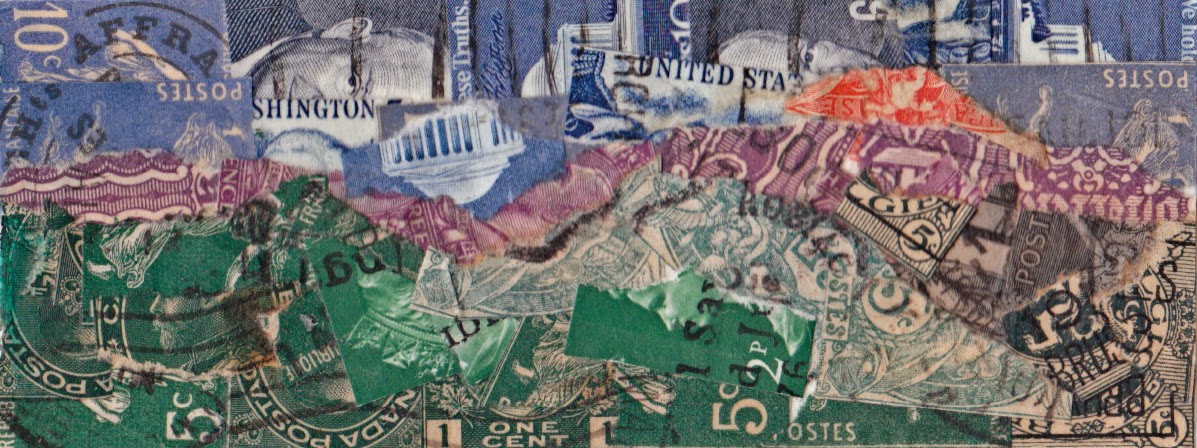
I don't collect stamps, although I admire them.  I have occasionally bought bags of old stamps, or children's stamp collections, for pocket change at a local resale shop.  I tend to organize them by color, for use in my collage work, like this:


I have bags of blue stamps, violet stamps, greens, and oranges/golds/browns, as well.  Some are from the USA, but many are not.  I also have little bags of stamps about writers and artists, the Olympics, holidays, and stamps commemorating US states and territories.  Frankly, I have no idea what to do with those. 

At any rate, I recently checked Nick Bantock's most recent book, The Trickster's Hat, out from our local library.  Unlike Urgent 2nd Class, which discusses more of the artist's technique and materials, The Tricker's Hat is a series of exercises meant to develop creativity both in writing and visual arts.  Perhaps some of the activities are from his workshops.  One of the exercises was to create a small (1.5 x 3 inch) collage using old postage stamps.  The idea was to work quickly, and create a small landscape using bits of stamps torn by hand.  He recommends cutting off the perforated white borders first.


This is what I came up with.  It won't set the world on fire, but it's interesting.  I have a real fondness for tiny artworks, especially those which incorporate bits of paper ephemera.  I find that people can often glide past a large painting and murmur sweet nothings, never really stopping to look closely.  But these little artworks make people stop, stare, and try to figure out what they are seeing. Here it's not only the wee engraving and portraits, it's also the cancellation stamp that leaves a bit of visual texture.  I was fascinated by the results.


This is my second attempt.  This time instead of  working completely from imagination, I had an old photo from a vacation. The original featured green fields in the foreground, a sliver of water, distant fields and a pale sky.  I'm not sure I like this collage as well, and perhaps it is because the torn stamp in no real way resemble the source.  Perhaps imagination is better for this sort of thing.


Friday, February 21, 2014

King Billy - Monarch Collage

7.5 x 7.5 inches, paper collage
contact me if you are interested in purchasing

Winter has been a beast, long cold, full of treacherous roads, and dim days.  So after I finished Barbara Kingsolver's novel (Flight Behavior) about, among other things, the way climate change is having a lethal effect on monarch butterflies, I decided to create something more colorful than much of my recent work.  The characters in Flight Behavior refer to the monarch as "King Billy", after the royal colors of William of Orange.

The papers in this collage include origami sheets, old magazine pages, sheet music, vintage receipts, and painted tissue paper.  The black part of the wings is acrylic paint, since the tiny white detail work just was beyond me. I started the piece about two weeks ago, then set it aside because we spent a week on the Pacific coast of Mexico.  When I returned to the studio the bright colors spoke to me even more, and I was inspired to finish it up.  This weekend I'll cut a mat for it, and then we'll see where it ends up.


Wednesday, January 2, 2013

It's time to look back at what I managed to read in 2012.  As I suspected, I read fewer title than in 2011, about seventy books.  Of those, I listened to about a dozen in audio format in the car, a way to multitask. This past year I found I read fewer titles, but took more notes, and chose more carefully than usual.  A number of my nonfiction titles were related to art, and I found myself really studying them, putting notes an sketches in my little journals.

I have associated myself with organized book groups a little less often than previously, mostly because of my reluctance to read titles chosen by other people.  If what other folks want to read and what I want to read happen to be the same I am delighted to join in a good discussion, but I am beginning to realize that my time on earth is limited, and if I don't get going on those books that are calling out to me, I may never get to them at all.  I am not, for example, a big fan of cozy mysteries, a genre that many many other people seem to enjoy very much.  I rather like speculative fiction and stories that feature supernatural themes, and I have learned that many other of my reading friends do not share that preference.  To paraphrase a poster on the topic of wine that used to be tacked inside one of my cupboard doors, "Life is too short to read uninteresting books."  Another reason book clubs are losing their appeal for me is that many of the participants seem primarily focused on general chit chat and food and drink.  Even my local library club started bringing plates of treats,  something I do not need,  though I enjoy.  So little by little I find my reading to be a solitary activity.

Here are a few nonfiction titles that I especially enjoyed last year.


 Canadian History for Dummies, by Will Ferguson,  was just what I wanted to help understand a little more about the political and economic forces that influenced New England ancestors on both sides of my family tree to live in Canada.  I was also fascinated by the parallels between US history and Canadian history, and the different spin Will Ferguson puts on events like the War of 1812.  The book was clear, and not too detailed for my general level of interest.


Jacqueline Kennedy: Historic Conversations on Life With John F. Kennedy, by Caroline Kennedy, was a boxed set of CDs, loaned to me by a friend.  I initially took them with little hope of being particularly interested, but both Caroline's introduction and the series of interviews with Jackie soon fascinated me.  Listening to her familiar voice, her opinions on living with "Jack" and all those 1960s politicians gave me new insight into her life as First Wife, and as a mother.


I have never spent too much time listening to Patti Smith as a singer, but I was happily engaged reading her memoir Just Kids about her relationship with artist and photographer Robert Mapptlethorpe.  Smith is able to recreate time and place in a clear and sometimes poetic way, and I found myself almost unable to put the book down.  I found myself making a playlist of music she mentions, just to help set the spirit of the times.


A few years ago, after I read The Orchid Thief, I became a fan of writer Susan Orlean, a woman I am convinced can make anything interesting.  Rin Tin Tin did not disappoint.  It is as much a portrait of the owner and promoter of the original Tin Tin Tin (there have been many dogs with that name), Lee Duncan, as it is the story of the famous German Shepherd.  While my choice of pet these days is a cat, when I was growing up my father owned and adored a series of German Shepherds, so I know how intelligent and loyal they can be.  This book keep my happy interest for a long time.


Truck,: A Love Story by Wisconsin author/musician Michael Perry, was another borrowed book.  My dad's cousin, a delightful and well read woman, loans me books she enjoyed, and I have the added pleasure of getting to discuss them with her.  Perry is  also well-read, and alternates between a no nonsense style and a sort of poetic style, especially when discussing things close to his heart - friends and family, gardens, and even an International truck that he and his buddy restored.  I find reading Perry to be reliably comfortable and familiar as a favorite flannel shirt. I've been listening to more Iris Dement and Greg Brown lately, too.


My last nonfiction recommendation was a book my husband read, liked, and passed on to me before it had to go back to the library.  Tomatoland: How Modern Industrial Agriculture Destroyed Our Most Alluring Fruit, by Barry Estabrook.  Probably everyone knows already that winter tomatoes are just red decoration on a plate.  They are hard and have no taste - like little alien imposters from a science fiction movies.  Estabrook not only explains how and why this happened, but also talks lots about how the agricultural workers who plant, weed, fertilize and harvest these red hockey pucks are often exploited.  It reinforced my feeling that the only tomatoes worth eating grows in a pot on my deck, or comes from my sister-in-law's garden.

There were other nonfiction titles I liked too, a biography with lush color reproduction of painting by Wolf Kahn, Just My Type, a book about typeface, who developed it and how it affects our impression of what we read, The Singing Wilderness, Sigurd Olson's essays about the northern wilderness through an entire year.  All of them informed and pleased me.  Happy reading in 2013 to everyone.


Wednesday, August 17, 2011

Book Review: The Way West, by A.B. Guthrie, Jr.


In the few years since I retired from teaching I've gotten deeply involved in researching family history, tracing the movements of an extended set of families as they moved westward from North Carolina to Ohio, Indiana, Iowa and Missouri, to Oregon, Washington and California.  At the same time my husband and I traveled to Washington and Oregon as tourists, and I took time to locate some of the living people from my family tree, and got some sense of where they lived and what their stories involved.  All that made reading this good book, The Way West, even better.  I would have read the book anyway, since I already liked historical fiction, and have enjoyed most of the Pulitzer prize winners I have tried.  But knowing that some of my ancestors came west over pretty much the same route that Guthrie describes here made me all the more interested.

This well-researched novel tells the story of the On-To-Oregon wagon train that left Independence, Missouri in 1845, headed for the head of the Willamette River, the Oregon Territory, where there was free land for homesteading.  There are many characters, so many in fact that if I had it to do over I'd start a list to keep as a book mark. Some of the major characters in Dick Summers, a former mountain man who is hired to guide the group on their way west.  There's Tadlock, an officious and difficult man who is the group's first leader, though he doesn't last - his place is taken by steady Lije Evans. There's Curtis Mack, whose wife is fearful of having a child along the long and difficult journey.  There is a family who choose to leave their Midwestern home because they want a healthier place to raise their young son who is prone to the fevers common in Missouri.  There is a preacher - handy for funerals and weddings.  Some folks are strong, some weak, some honest and forthright, others not. I found the shifting relationships among the leaders and followers to be fascinating, and I was caught up in the groups day-to-day struggles along the trail.  This is neither a cowboy and Indian shoot-em-up novel nor a history text.  Instead it is a heartfelt look at  how real people might have acted and felt during the epic journey along the Oregon Trail.  I also appreciated how much time was devoted to and credit given to the women characters. 

I wish I had found this Oregon Trail website before I started reading, because the maps, explanations, and photos would have helped me to visualize the group's journey more clearly.  You can see the site here: The Oregon Trail

I think I saw that a Kindle version of the book, with this website included is available for 99 cents.

Looks like now I need to check out the DVD of How the West Was Won, the Hollywood version of the 1949 book.  The last time I saw it I was a child at the movies.

Thursday, January 6, 2011

Nonfiction Titles I Enjoyed in 2010


Seems like a long reading road in 2010.  My nonfiction reading tends to related to art, and that personal interest is reflected in this year's nonfiction list.

Coop, by Michael Perry
Perry is a Wisconsin native, and writes with both humor and compassion about growing up, living and working in the Badger State. He has been a nurse, an EMT, farmer, musician and writer. He also is a very humorous speaker. This book chronicles some of his experiences in running a small farm, and trying to get a chicken coop built. It's not all humor, so beware.
Coop  A Year of Poultry, Pigs, and Parenting

Forbidden Fruit: The History of Women and Books in Art, by Christine Inman
I enjoyed this book on every level. There are four sections: First Steps: From the Cradle of Civilization to the Middle Ages; Piety and Luxury: Women Reading in the Sixteenth Through Eighteenth Centuries; Connecting With Books: The Nineteenth Century; Reading Becomes Art: The Twentieth Century. Each begins with an essay about women's literacy in the time period covered, followed by rich illustrations of paintings featuring women reading. Each plate also is discussed in some detail. It's about reading and it's also about art history. For me, it was very satisfying and enjoyable indeed.
Forbidden Fruit  The History of Women and Books in Art

Musicophilia, by Oliver Sacks
I am a person who cannot imagine life without music. I am not musically talented, although I whistle, hum, sing, bang away at my old piano. In the past I have also attempted to play a six string guitar and mountain dulcimer, with limited success. I can make noises on both the jaw harp and note flute, although I hesitate to call that music. In high school and college I sang in large choirs, where my thin soprano would be mostly lost, but I could be in the middle of people passionately making music, could feel the music in my entire body. I no longer sing. These days I mostly listen to music that other people make. I recently splurged on a gift for myself in honor of my sixtieth birthday and bought a Bose sound dock for my studio, and now spend many happy hours there listening while I work. Music serves to at least partially turn off the analytical part of my brain, the part that is ultra-critical, the part that keeps me from taking artistic risks. I work better with music. Oddly, I also am more successful at video games when I have music playing. When I was younger I could read with music playing in the background, but in the past few years have lost my ability to concentrate on words when there is music playing.

I'm sure neurologist and author Oliver Sacks could explain all this. Sacks is an author who I enjoy, although sometimes he goes into more scientific detail than I care to read. I've learned to selectively skip ahead when the science is too technical for my interest level. So far I have enjoyed several of his nonfiction books (The Man Who Mistook His Wife for a Hat, Awakenings, Island of the Colorblind, An Anthropologist on Mars), all of which tell stories of people with neurological differences cause by strokes, disease, physical trauma, or genetic accident. In Musicophilia Sacks covers a wide range of topics related to music and brain function. He discusses musical hallucinations, tunes that become stuck in your brain and why that happens, perfect pitch, the relationship between music and blindness, people who cannot enjoy or appreciate music, and therapeutic applications for music. I found reading about ways that music can accelerate physical healing and be helpful for aphasic patients and people suffering from various sorts of dementia, to be gripping and thought provoking.
Musicophilia  Tales of Music and the Brain

Picture This, by Lynda Barry
Barry is well known for her comic book creations, especially Marlys and Ernie Pook. She lives just a few miles away from my town, married to a man who re-establishes prairies. She also is very generous with her time, running writing and art-related workshops, giving talks. This book has a new character, the near-sighted monkey, and she uses the character to illustrate why she thinks drawing, even doodling, is good for a person creativity, sanity, and perhaps even soul. I've been drawing Zen monkeys for a month.
Picture This

The Art Spirit, by Robert Henri
On a more serious note, The Art Spirit is a collection of essays and lectures given by the famous painter. I took so many notes that I think I'll just find an old copy and buy it to reread whenever I go into a slump.
The Art Spirit  Notes, Articles, Fragments of Letters and Talks to Students, Bearing on the Concept and Technique of Picture Making, the Study of Art Generally, and on Appreciation (Icon Editions)

Undaunted Courage, by Stephen Ambrose
In general I don't have a compelling interest in history, but I wanted an audio book for a driving trip, and this was the only cassette tape set left at the library that interested me at all (my CD played died in the car). To my surprise, I was fascinated by the story Ambrose tells. It didn't hurt that much of it was set in places I have visited, especially Washington and Oregon. At any rate, I enjoyed his writing very much indeed.
Undaunted Courage

The Undressed Art: Why We Draw, by Peter Steinhart
In an effort to improve my drawing from direct observation, I have been attending life drawing sessions at local colleges - at least when the roads are good. I'm a chicken on icy roads, but I digress. This book was being passed hand to hand last summer in one of the weekly sessions, and I finally ordered it inter-library loan. I didn't write a review at the time, but the book is far-ranging, covering topics such as how a child's approach to drawing evolves, how the brain perceives images, what life drawing groups are like, and the role of the model in life drawing classes. I enjoyed the writing and the topic.

Wednesday, January 5, 2011

Favorite Fiction 2010

Taken at my sister-in-law's place in Door County a year ago.  Winter is a great time for reading, and reflecting.

As promised, here is a list of ten of my favorite fiction reads in 2010.  This year I read 80 books, far fewer than I read in 2009.  Over half were fiction, a percentage that seems to grow each year.  I blame it on the fact that the CD player in our automobile finally went home to the lord, and I couldn't listen to audio books while driving after early spring.  I did listen to a couple of cassette tapes, but there are fewer and fewer available to check out from the Hedberg Library, as they gradually purge the tape collection in favor of CDs and "play-away" technology.  It was more than that though.  We traveled lots.  I worked on art lots.  And I played Bejeweled Blitz on Facebook, something that also ate into my time set aside for exercise.  

Enough excuses.  These were some titles that I found to be especially satisfying.

Annie Dunne, by Sebastian Barry
"Oh, Kelsha is a distant place, over the mountains from everywhere."  The opening line of Sebastian Barry's 2002 novel is spoken by the book's narrator, Annie Dunne.  I liked the book fine for its subtle characterizations and poetic language, but it won't be for everyone.  Fact is, not much happens, and many people will not like Annie.  In general, Annie, who is unmarried, born with a crooked back, and in her sixties, is unhappy and cantankerous, and afraid that the way of life she has known is passing away and that there is no place any more for her in her world.  She lives with her friend Sarah on a remote farm, and one summer gets to take care of her grand-niece and nephew - something that has its good and bad days.  Then it looks like Sarah might marry, and where would Annie go?  This is a quiet book, and a thoughtful one, that leads the reader to consider what is important in a person's life.

Being Dead, by Jim Crace
"For old time' sake the doctors of zoology had driven out of town that Tuesday afternoon to make a final visit to the singing salt dunes at Baritone Bay."This is a short book about the lives and deaths of Joseph and Celice, a married couple whose unsentimental lives are chronicled in prose both straightforward and poetic.  They die, they decay, and their entwined lives are considered in an unforgettable way.  Be forewarned, this is not for the squeamish reader, but the story held me.

The Cellist of Sarajevo, by Steven Galloway
"It screamed downward, splitting air and sky without effort."
"It" is a bomb in Sarajevo, the setting of The Cellist of Sarajevo.  The book came highly recommended to me, and because of that, plus the fact it is a short novel, I dove into it.  It took a while for me to see how the four stories of people living in the Serbian city during its siege in the 1990s were related.  By the end, though, I saw what the very different people had in common, besides their unhappy lot of living in a city at war. The novel describes some very terrible things in a quiet and dispassionate way, but the final impression I am left with isn't how horrible people can be, but rather how fine.

Cutting For Stone, by Abraham Verghese
"After eight months spent in the obscurity of our mother's womb, my brother, Shiva, and I came into the world in the late afternoon of the twentieth of September in the year of grace 1954."Cutting for Stone came highly recommended to me by two friends whose opinions I value, and their good opinion was well justified.  I had put off reading this one because of its length, 541 pages, but I ended up savoring the story of identical twin brothers who each love the same woman, and each of whom becomes a doctor.  It's a sprawling novel that begins and ends in Ethiopia, and in the middle travels to the United States.  While I was interested in some of the historical events covered in the story and information about Ethiopian culture, the real interest for me was the story of the boys and their families.  The writing here is wonderful - flowing, observant, humane.  I was sorry to see it all end.

East of Eden, by John Steinbeck (re-read)
This was the first book I read in 2010, and for a while nothing lived up to it.  I didn’t write a review at the time, so my grasp of details has slipped.  But suffice it to say this is a sprawling multi-generational novel that traces the history of a family of California settlers.  Everything I read said the plot broadly follows the story of Cain and Abel, and certainly there is a great rift between the two brothers in the  story, but the novel is broader, richer than that. Steinbeck stirs together history, autobiography, legend, philosophy, and even poetry to make a book that is hard to put down (even though it weighs a ton!), and hard to forget.

Let the Great World Spin, by Colum McCann
"Those who saw him hushed."  Let the Great World Spin came highly recommended by a book friend whose taste I trust, and this one was as good as I hoped.  The novel's plot lines all come back to the day in 1974 when a French wire walker held NYC spellbound by dancing back and forth between the towers of the World Trade Center.  There are beautiful chapters about that walk, but the bulk of the novel consists of interwoven threads about New Yorkers who saw or heard about the event.  There's an Irish priest who ministers to streetwalkers, women who lost sons in the Vietnam war, a judge, and more.  Each of walks his or her own dangerous path. I was charmed by the characters and the writing, but I expect some readers will be impatient with the fragmented narrative.  Thumbs up from me.

The Little Stranger, by Sarah Waters.
"I first saw Hundreds Hall when I was ten years old."  Our narrator was the son of a maid at the hall, and when he was allowed his first peek at the mansion he pinched a plaster acorn from a frieze on the wall.  Years later (in 1947) , after his parents are gone and he has become a country doctor, he once again visits the house to treat a sick maid, and we're off.  One one level the story is a Gothic romance, complete with a decaying but once fine mansion out in the countryside, dim and dusty rooms, steep staircases, locked nurseries, tales of ghosts, mysterious marks on both the house and the inhabitants, strange noises, insanity, death, and frustrated love.  As I read I kept flashing scenes from classic horror, The Turn of the Screw, Fall of the House of Usher, The Haunting of Hill House, even the creepy old house bits from Great Expectations.  But there is more, a sense of loss, sadness, a passing of a way of life that is historic rather than simply creepy.  The story begins rather slowly, but little by little I found myself turning the pages more quickly, reluctant to stop, and a little afraid to turn out the lights.

Olive Kitteridge, by Elizabeth Strout
Even though this was one of my favorite fiction reads for 2010, I neglected to review it immediately after I finished the book.  I know this novel polarized many readers - many disliked the dark tone of the thirteen inter-related stories, or thought Olive was unlikeable.  I was completely caught up in each separate story, and the way they told the story of Olive’s life, and of the lives of others in her small Maine town.  My heart went out to this woman whose life, like many people’s lives, is hard.  Her crustiness is a self-defense, and underneath it she has a good heart.  I loved the quiet writing in this book, the unflinching look at the joys and heartaches that make up our lives.

The Travels of Jaimie McPheeters, by Robert Lewis Taylor (re-read)
I just finished a second reading of The Travels of Jaimie McPheeters, as always a little afraid that I wouldn't like it as well as I remembered.  The novel begins this way: "On the day when I first learned of my father's journey, I had come back with two companions from a satisfactory afternoon in the weeds near Kay's Bell Foundry, shooting a slingshot at the new bells, which were lying out in the year and strung up on rafters."  Jaimie narrates the story, and the journey is as much his as his father's. Soon enough the shooting that happens is with guns, not slingshots.  This rambling odyssey of a story covers a year in the life of Jaimie and his father, who leave Louisville to escape debt and find fortune in California.  The adventure of crossing the country by wagon train is filled by turns with humor and horror.  The author includes an extensive bibliography of work he used for research, including many narratives of travelers on the Oregon Trail.  I had the feeling that descriptions of privation, Indian attacks, experiences with the Mormons, all had their basis in the true experiences of pioneers.  It is an interesting book, with likable characters, filled with history, adventure, and danger.  I'm not sure I'd recommend it for young readers, not only because it runs more than 500 pages, but because of the occasional gut-wrenching violence.  Travel across the prairies, mountains and deserts of America in the 1860s was not for the faint of heart.  Still, I found myself impatient each day to return to the story, anxious to see what became of the wanderers, and whether or not they ever found home. I am happy I was able to revisit this fine novel.


Sunday, December 19, 2010

Musings on Music


I am a person who cannot imagine life without music.  I am not musically talented, although I whistle, hum, sing, bang away at my old piano.  In the past I have also attempted to play a six string guitar and mountain dulcimer, with limited success.  I can make noises on both the jaw harp and note flute, although I hesitate to call that music.  In high school and college I sang in large choirs, where my thin soprano would be mostly lost, but I could be in the middle of people passionately making music, could feel it in my entire body.  Last year, when I attended our community's annual walk in Messiah concert, I was disappointed almost to the point of tears to realize that after years of straining my voice in the classroom, I could no longer make any sort of pleasant music with that instrument.  Out of concern for others, this year I will stay home.

So, in my dotage I mostly listen to music that other people make, and mostly on my computer or iPod.  I splurged on a gift for myself in honor of my upcoming sixtieth birthday and bought a Bose sound dock for my studio, and now spend many happy hours there listening while I work.  Music serves to at least partially turn off the analytical part of my brain, the part that is ultra-critical, the part that keeps me from taking artistic risks.  I work better with music.  Oddly, I also am more successful at video games when I have music playing.  When I was younger I could read with music playing in the background, but in the past few years have lost my ability to concentrate on words when there is music playing.

I'm sure neurologist and author Oliver Sacks could explain all this.  Sacks is an author who I almost always enjoy, although sometimes he goes into more scientific detail than I care to read. I've learned to selectively skip ahead when the science is too technical for my interest level.  So far I have enjoyed several of his nonfiction books (The Man Who Mistook His Wife for a Hat, Awakenings, Island of the Colorblind, An Anthropologist on Mars), all of which tell stories of people with neurological differences cause by strokes, disease, physical trauma, or genetic accident.  Without fail, Sacks' descriptions of how these people perceive the world, and how their differences are not always deficits, are instructive and entertaining. 

In Musicolphilia Sacks covers a wide range of topics related to music and brain function.  He discusses musical hallucinations, tunes that become stuck in your brain and why that happens, perfect pitch, the relationship between music and blindness, people who cannot enjoy or appreciate music, and therapeutic applications for music.  I found reading about ways that music can accelerate physical healing and be helpful for aphasic patients and people suffering from various sorts of dementia, to be gripping and thought provoking.  From the cover blurb, this seems to sum it up: Music is irresistible, haunting, and unforgettable, and in Musicophilia, Oliver Sacks tells us why.

I also found a couple new composers and songs to add to my iPod.

Wednesday, May 26, 2010

Looking For Lace

Lace maker, Burano Italy, March 2010

Although I am not a person who especially likes or wears lace, I admire it.  I was fascinated by the women in Italy who make handmade lace, toiling for a year to create a table cloth, or maybe a bedspread.  Cat people like me don't have lace bedspreads.  Anyway, our local library has started a contemporary fiction book discussion group, and the first title I read for it was The Lace Reader, by Bruonia Barry.  Set in contemporary Salem, the novel features a circle of women who make lace, and who learn to "read" it - much as one might read tea leaves, or palms.  There's more to it of course, an unreliable narrator who returns to Salem after the death of her aunt, and discovers there are many questions to be answered about her own life.  Each chapter is introduced with a selection from the fictional "Lace Reader's Guide."  This one at the beginning of Part Two appealed to me:


There is lace in every living thing: the bare branches of winter, the patterns of clouds, the surface of water as it ripples in the breeze . . . . Even the wild dog's matted fur shows a lace pattern if you look at it closely enough. 


That little idea sent me out to my spring garden to look for lace.


Mementos, 1
by W.D. Snodgrass

Sorting out letters and piles of my old
    Canceled checks, old clippings, and yellow note cards   
That meant something once, I happened to find
    Your picture. That picture. I stopped there cold,   
Like a man raking piles of dead leaves in his yard
             Who has turned up a severed hand.

Still, that first second, I was glad: you stand
    Just as you stood—shy, delicate, slender,
In that long gown of green lace netting and daisies
    That you wore to our first dance. The sight of you stunned   
Us all. Well, our needs were different, then,
             And our ideals came easy.

Then through the war and those two long years
    Overseas, the Japanese dead in their shacks   
Among dishes, dolls, and lost shoes; I carried
    This glimpse of you, there, to choke down my fear,   
Prove it had been, that it might come back.
             That was before we got married.

—Before we drained out one another’s force   
    With lies, self-denial, unspoken regret
And the sick eyes that blame; before the divorce
    And the treachery. Say it: before we met. Still,   
I put back your picture. Someday, in due course,
             I will find that it’s still there.


Sunday, May 16, 2010

Theodore Robinson, Local Connections

Self Portrait, Theodore Robinson 1884-1887

Last week I attended a luncheon of the Janesville Art League and had expected only a nice salad, some chit chat with friends and a vote on next year's leadership.  I was also interested a presentation by Richard Krake, retired art educator and painter from nearby Evansville, about native son Theodore Robinson. I was well aware of another painter from Evansville, John Wilde, but I had never heard of Robinson, who lived much of his early life in Evansville and is buried there.

That led me to do a little searching for more about Robinson's life.  In brief, he was born in Vermont, but then his family moved to Evansville, a small town not far from here.  He had asthma, so his mother kept him inside much of the time, encouraging him to draw and learn piano.  He studied art in Chicago and New York, and also traveled to France and Italy.  In the 1880s he became friends with Claude Monet and other European Impressionists, and his style became looser and more impressionistic. He eventually returned to the United States, taught, and was part of the Cos Cob Art Colony.  He died of an asthma attack, and was buried in Evansville. Today his work is at the Metropolitan Museum of Art in New York City, the Corcoran Gallery of Art, and the Art Institute of Chicago.  Apparently there are some paintings in private collections in Evansville as well.

The Wedding March - shows Monet's daughter's wedding

I plan to read a book the speaker mentioned about Robinson's work entitled In Monet's Light: Theodore Robinson at Giverny. 


Saturday, April 17, 2010

Inspired by a Marge Piercy Poem

vintage bluebird trading card

I headed out to my Thursday painting group this week only to discover that it had been canceled, and I was not informed.  Rather than stew over this inconvenience I headed out for a latte and a browse through a local used book store, where I found a good copy of The Moon is Always Female, poems by Marge Piercy.  This one stood out for me.  When people say that I am talented (this doesn't happen every day by any means) I always think that a decent painting is more the result of years of working at it than some trait I inherited from my mother or great aunt, like straight hair or green eyes.  Anyway, I liked the poem.


For the young who want to

Talent is what they say
you have after the novel
is published and favorably
reviewed.  Beforehand what
you have is a tedious
delusion, a hobby like knitting.

Work is what you have done
after the play is produced
and the audience claps.
Before that friends keep asking
when you are planning to go
out and get a job.

Genius is what they know you
had after the third volume
of remarkable poems.  Earlier
they accuse you of withdrawing,
and ask why you don't have a baby,
call you a bum.

The reason people want M.F.A.'s,
take workshops with fancy names
when all you can really
learn is a few techniques,
typing instructions and some-
body else's mannerisms

is that every artist lacks
a license to hand on the wall
like your optician, your vet
proving you may be a clumsy sadist
whose fillings fall into the stew
but you're certified a dentist.

The real writer is one
who really writes.  Talent
is an invention like pholgiston
after the fact of fire.
Work is its own cure.  You have to
like it better than being loved.